

Welcome to the second edition of Mikhail’s Travel Adventures!
As you know from previous posts, I quit my job in September 2017 and embarked on a journey of self-discovery: a 2-month road trip across the US and Canada.
I reached California in November and spent the holidays with family. Then, in January, I bought a one-way ticket to Singapore and spent 3 months backpacking in Asia! This second installment of my blog will attempt to cover my adventures in Singapore, Indonesia, Thailand, Cambodia, Vietnam, Hong Kong, Taiwan, and South Korea. Hope you enjoy reminiscing with me 🙂

While I was traveling solo for most of my Asia trip, I was lucky to have my friend Alec join me for the first 2 weeks. Together we had some fantastic adventures in Singapore, Bali, and Thailand. Let’s get right to it!
Singapore Overview
Singapore is an island city-state in Southeast Asia, ~100 miles north of the equator. Once a fishing village that grew into a trading settlement under the rule of Malay empires, modern Singapore was founded in 1819 when the British East India Trading Co. established a trading port. Unlike the other “nearby” ports owned by the Dutch, Singapore’s port was tax-free and was thus favored by merchants. It became the region’s busiest port by the late 1800s; the city remained under British control until 1963 and gained full independence in 1965.
Singapore has a population of ~5.6M people with 39% foreign nationals. It has 4 official languages: English, Malay, Chinese, and Tamil. Despite its small size and lack of natural resources Singapore is extremely modern and developed; it’s ranked #9 on the UN Development Index! For reference, Norway is #1 and the US is #15.

Singapore is one of the world’s financial centers and its high-growth economy is ranked 3rd least corrupt in the world, behind Denmark and New Zealand. The US is 22nd and Russia is 138th..
Criminal Law
Given its advanced economy, Singapore’s criminal punishment system seems surprisingly strict. Many activities found harmless by other developed countries are criminalized; severe offenses are subject to corporal (caning) and capital (hanging) punishment.
Criminalized offenses include littering, jaywalking, the possession of pornography, the sale of chewing gum, and gay sex (but only between men). Note that some these may be punished by fines and/or jail time (and possibly caning).
Somewhat amusingly, if you use a public toilet you are legally obligated to flush it. If only we had this law in the US!
Caning
Caning was introduced by the British Empire in the 19th century; at that time such punishment was common in England.
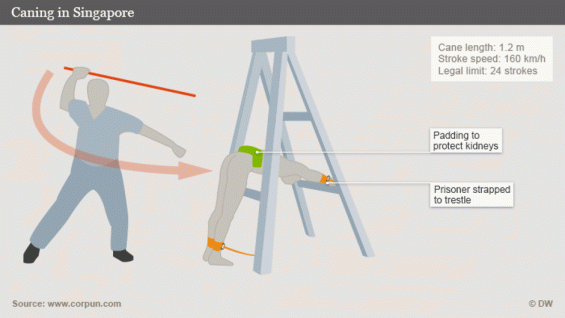
Singaporean law allows caning to be ordered for over 35 criminal offenses, including kidnapping, robbery, and vandalism. Additionally, foreigners who overstay their visa by more than 90 days could be caned. Needless to say Alec and I were careful not to overstay our welcome!
Some more fun facts about caning:
- Always administered in conjunction with a prison sentence
- Only applies to males under 50 in a “fit state of health”
- The number of strokes depends on the severity of the offense but may not exceed 24 for a single trial; caning sentences commonly specify between 3 and 6
- For better or worse, someone sentenced to death cannot be caned.
In 2016, 1257 people were sentenced to canings.
Hanging
Singapore supports the death penalty which is executed (no pun intended) by “long drop hanging.” A controversial subject in the US, capital punishment is supported by most Singaporeans: in a 2005 survey, 95% were in favor of keeping the death penalty.
Hanging is carried out for offenses such as murder, firearm use, and drug possession. In 2018, 13 people were hanged. Singapore doesn’t mess around!
While Singapore’s punishment system seems draconian, it’s hard to argue with its effectiveness – Singapore has one of the lowest violent crime rates in the world and has the same (very low) homicide rate as Japan.
The punishment system is one of many tradeoffs Singapore has made between individual liberties and economic growth/security. Singapore’s citizens have accepted giving up certain individual freedoms (e.g. chewing gum or shooting guns) for the general benefit of the community (more clean, safe). Such compromise of freedoms is, of course, very foreign to those living in the US.
Arrival
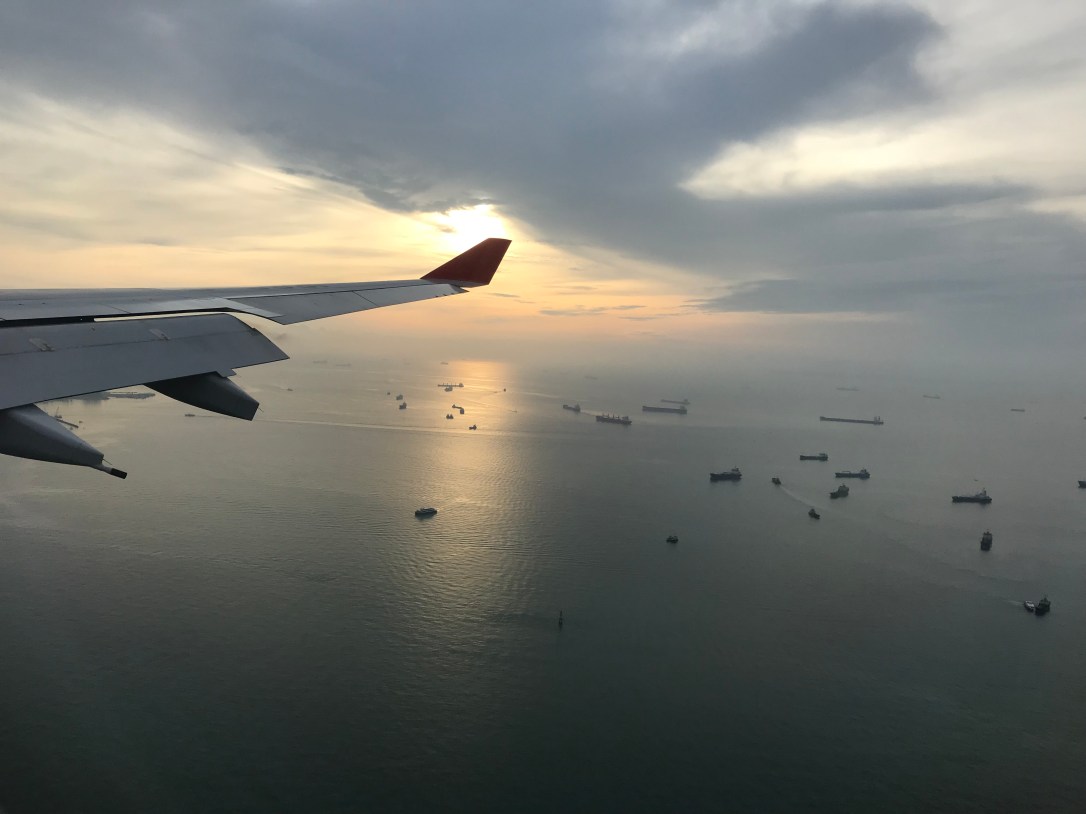
Alec and I landed around 10am at Singapore’s Changi airport which consistently ranks as the best in the world and feels like a Vegas hotel.


After admiring the incredible airport we Ubered to our tiny hotel room. I napped while the restless Alec went exploring. Our hotel was near the Muslim quarter so a few hours later we headed to Arab street for dinner at Zam Zam, an Indian-Muslim restaurant.

The restaurant asserts that this Zam Zam is the only real location, and any other restaurant that calls themselves Zam Zam is an impostor. The food here certainly tasted like the real deal!

Gardens by the Bay
After a restful night’s sleep (jk I woke Alec up after stepping on his foot at 6am) we grabbed a traditional Singaporean kaya toast breakfast. Kaya is a topping made of sugar, coconut milk, eggs, pandan, and butter. A must-try Singaporean breakfast staple, kaya is usually served on toast.

After a delicious breakfast we Ubered to Gardens by the Bay, one of the most iconic attractions in Singapore. Gardens by the Bay, completed in 2012, is a nature park with several beautiful waterfront gardens. The name checks out.

One of the main features here is the Supertree Grove, an impressive collection of 18 tree-like structures. Each “tree” is home to exotic plants and is also equipped with modern environmental technologies: solar cells for powering the lights and rainwater collection for irrigation and fountain displays.

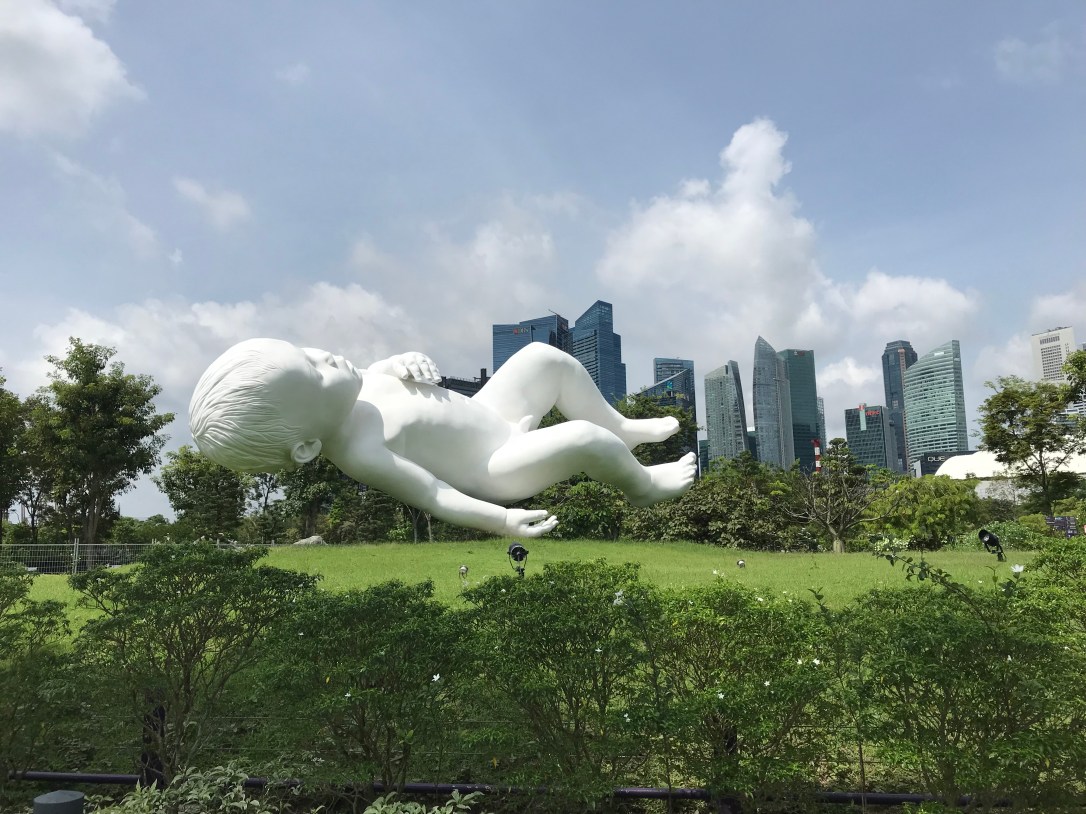

After a superwalk in the Supertrees we headed to the iconic Marina Bay Sands hotel (though sadly didn’t get a chance to grab those Insta-worthy shots at the famous infinity pool). The walk wasn’t free of adventure, however, as I temporarily lost my hat in the wind. Luckily I was able to chase it down to ensure my continued sun protection. What a close call!
Walking Tour
After lunch Alec and I headed to the Sneakpeek Singapore free walking tour, which we thought started at 1:30. Turns out the tour actually started at 1! Lucky for us the group was still there, and Darren, the guide, asked us if we had registered. We hadn’t, but Darren was nice and allowed us to stay.

Darren was an awesome tour guide. He was super knowledgeable and very excited about Singapore, which aligned with the online description. According to the tour website, the guides are usually “passionate” university students. Darren was certainly passionate and indeed was finishing up his final year at university. No surprises there!

Darren had a lot of great stores, including some about his family history. He said that during WWII, when Singapore was occupied by Japan, his family changed their last name to that of a deceased Japanese family so that they could get ration cards.

During Singapore’s first financial crisis in the 1980s the government consulted with a Feng Shui master who said the belly of the fish (representing the Boat Quay built for unloading ships) is pierced by metro tunnels, bringing bad luck. The master recommended that Singapore introduce octagon-shaped objects to the city to spread good luck. Following this the government added octagon-shaped $1 coins and car registration stickers, among other octagon-shaped items. Today, the octagon symbol is everywhere.
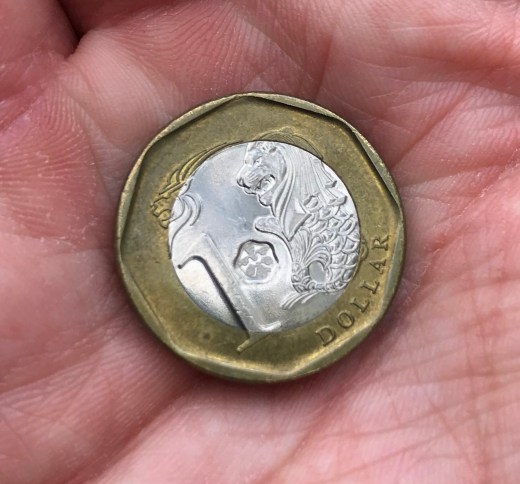
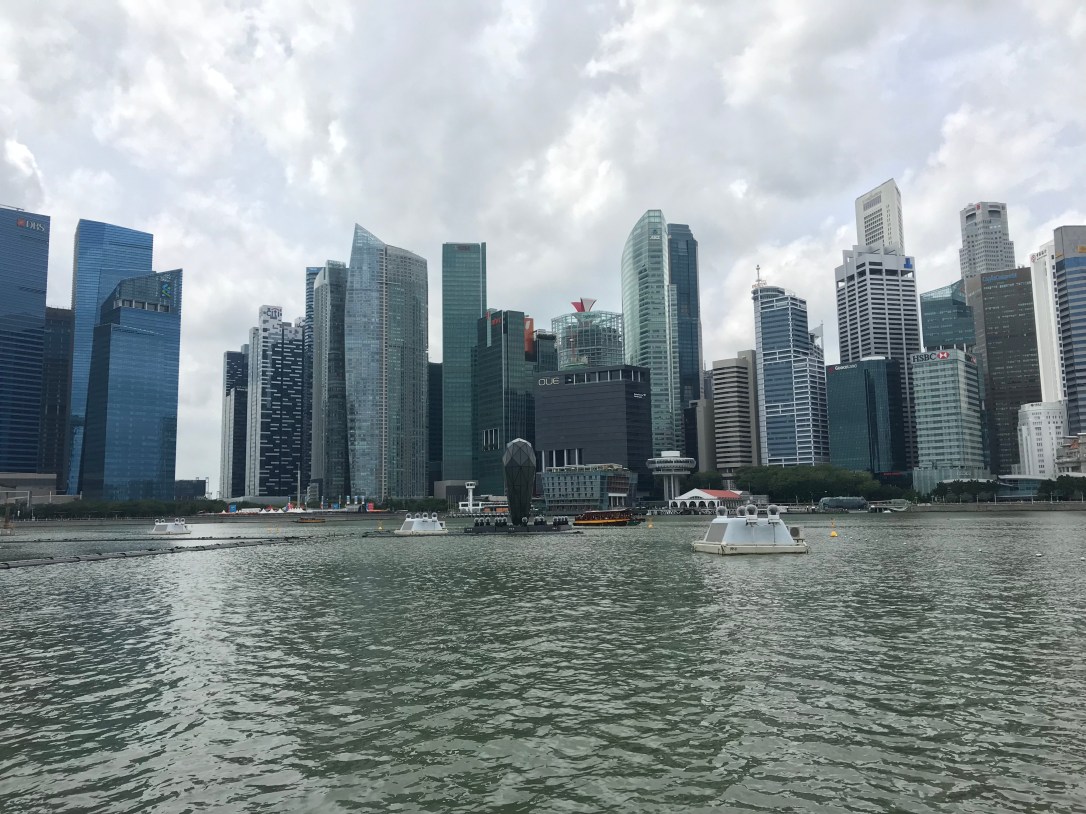
As we walked by the countless skyscrapers I noticed that many buildings have entire floors dedicated to gardens and terraces. As it turns out Singapore has an incentive program for building developers which aims to replace greenery lost on the ground with greenery in the sky. What a cool concept!

Of course Darren talked about Singapore’s tradeoffs between individualism and the common good. He described it as a hyper-pragmatic place where the people are OK letting the government decide what is best for the community.
While present-day Singaporean society functions well with this tradeoff in mind, the journey hasn’t been simple. To discourage the long hair style of the counterculture 1970s Singapore enacted laws forcing men with long hair to be served last in government offices. If that wasn’t enough, the country wouldn’t allow Led Zeppelin in when the band refused to cut their hair.

The ban on chewing gum is in the same realm, albeit more practical. The local railway system, the MRT, started running in 1987. Occasional vandals would stick their gum on the train door sensors, preventing them from closing properly. This caused heavy disruption and was difficult to prevent so in 1992 the prime minister instituted a ban. Radical, but today Singapore’s rail system functions like clockwork.
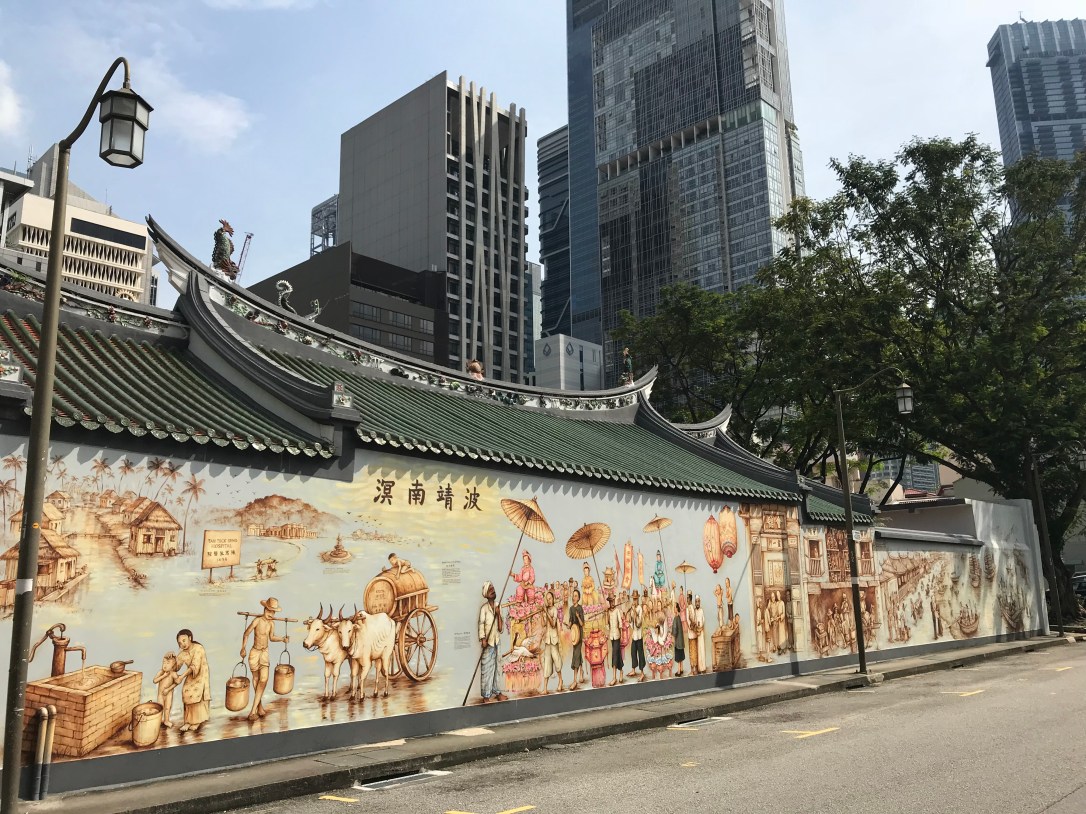
Criminalizing certain goods and activities is one approach to control the public’s behavior; another is taxation. To discourage Singaporeans from owning cars the government taxes them heavily: a permit to allow you to buy a sedan costs between $30k and $50k (USD). A small-sized Toyota costs about $70k, so your shiny new car could cost you well over $100k. At least the permit lasts for 10 years…

We couldn’t do a proper tour of Singapore without stopping at one of the famous hawker centers (food courts). Our group went to Maxwell Food Centre, filled with booths (hawker stands) selling tasty snacks ranging from fruit smoothies to curry and fried rice.

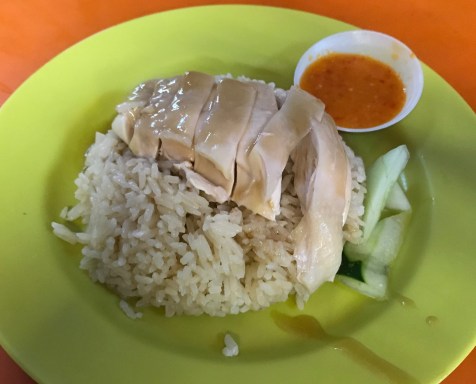
My favorite was the famous Tian Tian Hainanese Chicken Rice stand.
After his upcoming graduation Darren was set to work for the Urban Redevelopment Authority, Singapore’s city planning office. Thus our lucky tour group made a brief stop at the administrative building, which at first didn’t seem particularly exciting. However, when we got there it turned out that they had a 3D city model on display! The model had current and future building developments which depicted the city planners’ vision for Singapore over the next decade or so. So cool!

Our last stop of the tour was a public housing building. Public housing is quite remarkable in Singapore and is totally different from the US projects.
Singapore had a severe housing shortage in the 1960s so the government set out to build low-cost housing, initially meant as rentals for low income citizens. Over the years subsidies for purchase by middle income citizens were introduced as well.
Public housing is organized into housing blocks, or estates, built and managed by Singapore’s Housing and Development Board. These estates are self-contained satellite towns with their own schools, stores, hospitals, food courts, etc. Every housing estate has metro stations and bus stops. It’s as if your apartment building suddenly became a small self-sufficient city!

The public housing program has had tremendous success, with Singapore reaching a 91% home-ownership rate (US homeownership rate is 65%), and 80% of all Singaporeans living in public housing. One caveat is that only Singapore citizens are eligible for this program (with up to 5% available for permanent residents). There are also ethnic quotas designed to avoid racial segregation: each block of units is sold to families of ethnic distributions approximating the national averages. In other words, each housing block should contain ~76% Chinese families since Singapore’s population is 76% Chinese.
Of course only those who need the subsidies (those making under $105k USD annually) are eligible for public housing. Additionally, the policy prioritizes “family units” which favors married couples. According to Darren a popular joke among Singapore’s youth is, instead of asking “will you marry me?” to ask “will you buy a house with me?”.
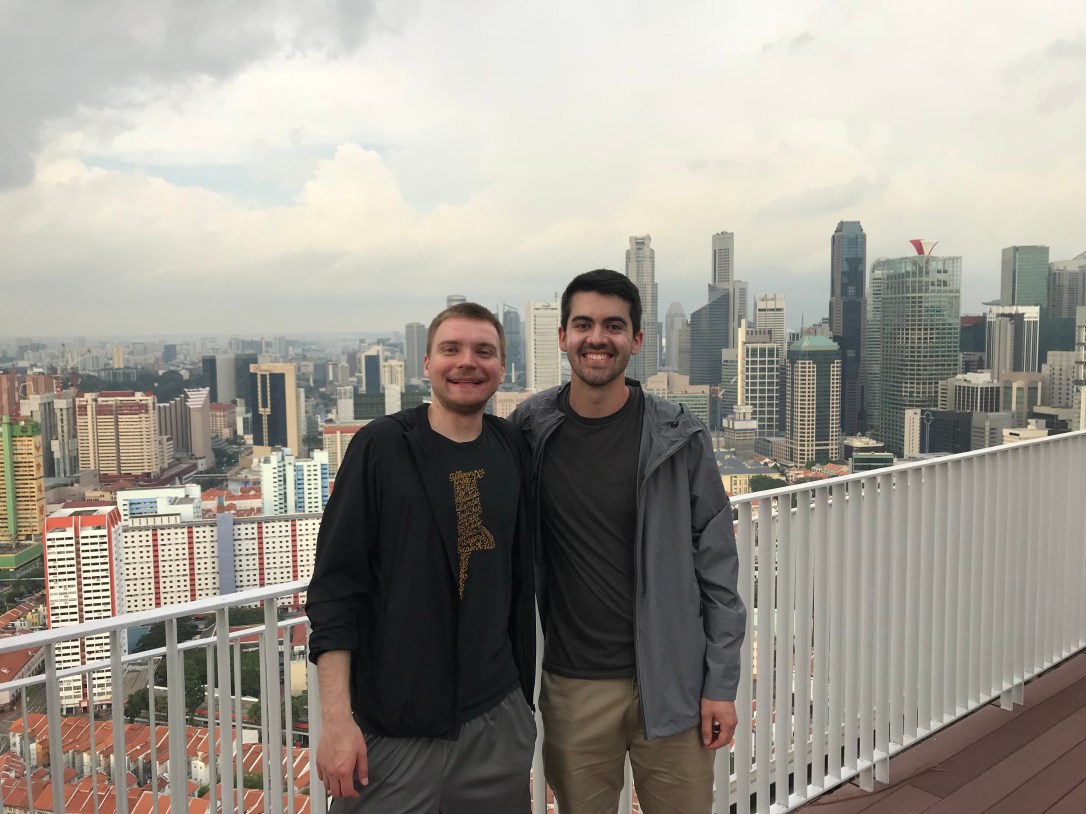
This incredible view concluded our amazing 5-hour walking tour. We were exhausted but very thankful to Darren for teaching us so much about Singapore. The tour ended up being one of the highlights of my entire Asia trip!
Gardens by the Bay, Part II
After taking a rest we headed over to Gardens by the Bay to see a nightly light and music show called the Garden Rhapsody.
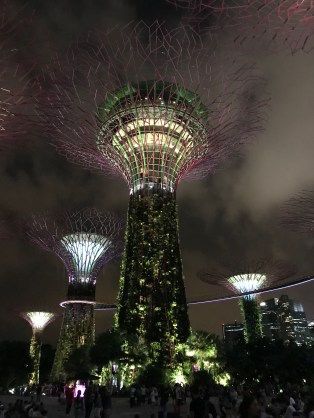
The performance was amazing and afterwards we repeated yesterday’s scenic walk to the Marina Bay Sands hotel.

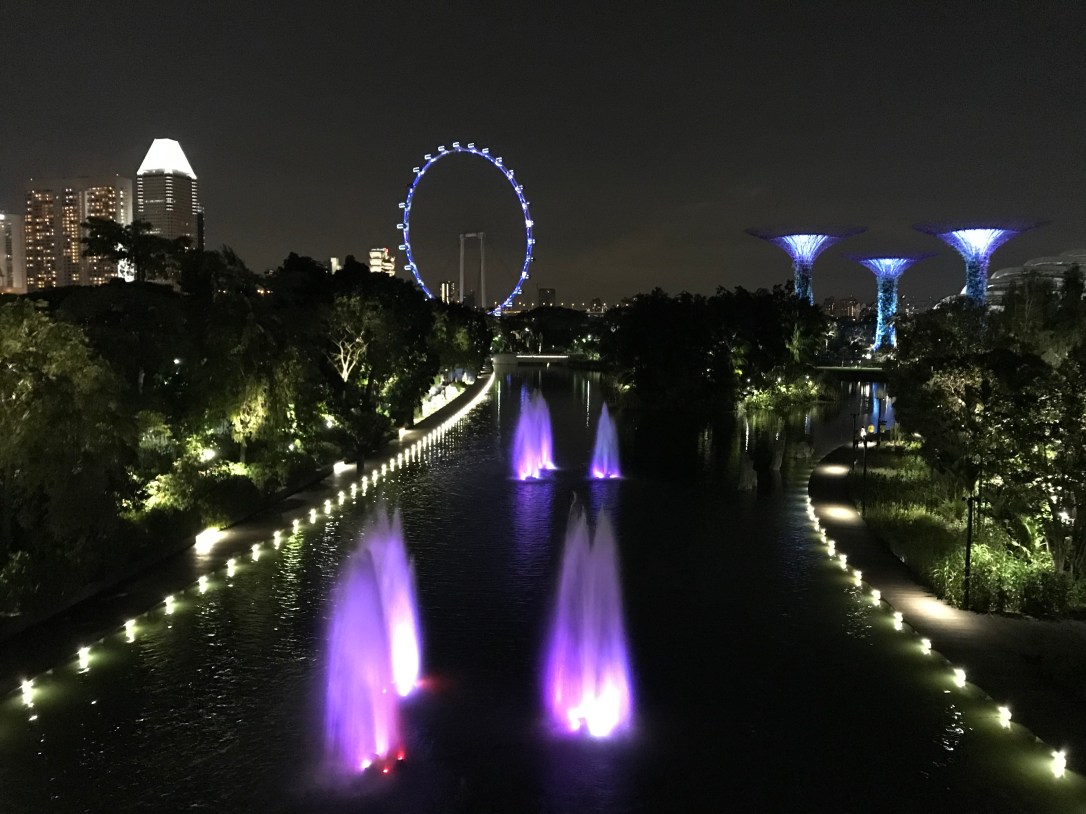
After the amazing lights display Alec and I headed once again to Maxwell Centre, this time to meet Alec’s friend for dinner. After some pork buns, wonton noodles, and coconuts, we headed to the rooftop bar CE LA VI.

Merlion
The next day we headed to the Merlion statue, Singapore’s official mascot. The Merlion is a mythical creature with the body of a fish (for Singapore’s origin as a fishing village) and the head of a lion (for Singapore’s original name Singapura — lion’s head).
Our Uber driver told us that Singapore is a “fine city” due to its numerous laws and the fines for breaking them.
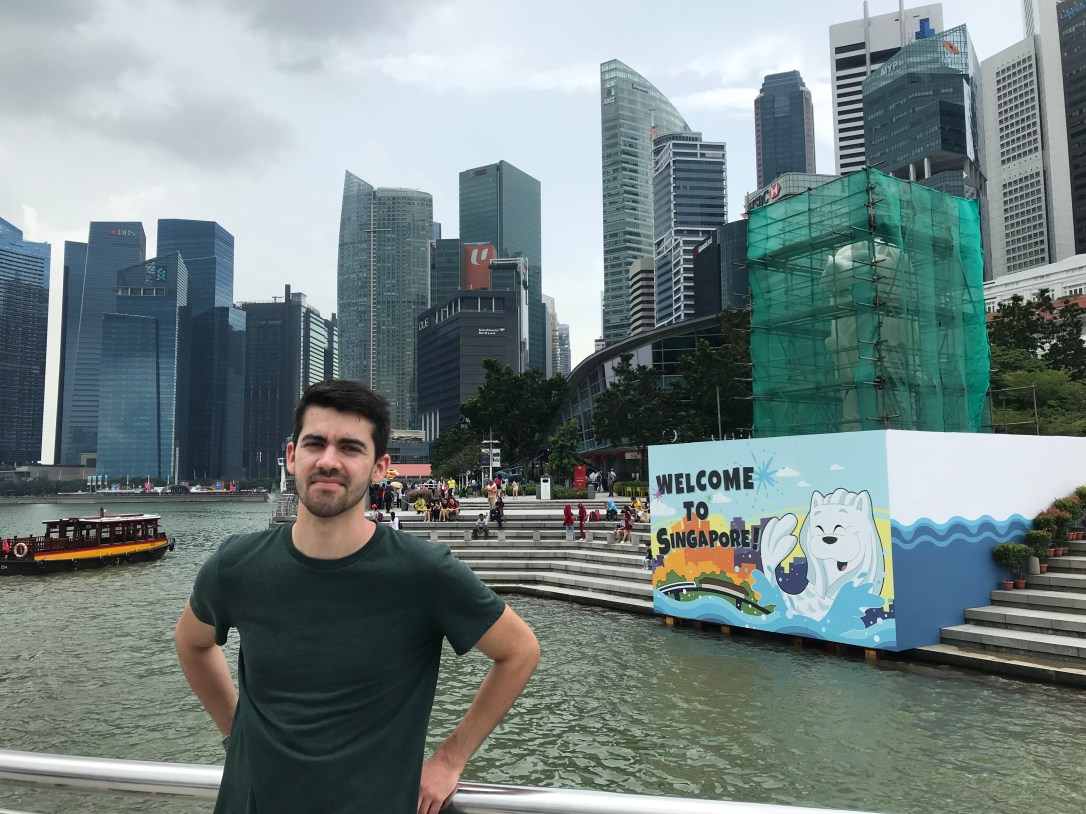
A Malaysian family wanted to take photos with us due to our exotic appearance. Can’t blame them!


After our adventure with the elusive Merlion and the nice family it started pouring so we headed to Maxwell Centre (a third time) for a late lunch. I got my favorite Tian Tian chicken and rice, a deep fried banana, and a soursop/dragonfruit smoothie. Delicious!
After lunch we walked to a cat cafe but the cover was $12 and since Alec and I are both allergic to cats, we didn’t go in. Not sure why it ever sounded like a good idea.
“How do you find out if someone is allergic to cats?” “They tell you.”
Gardens by the Bay, Part III: Cloud Forest
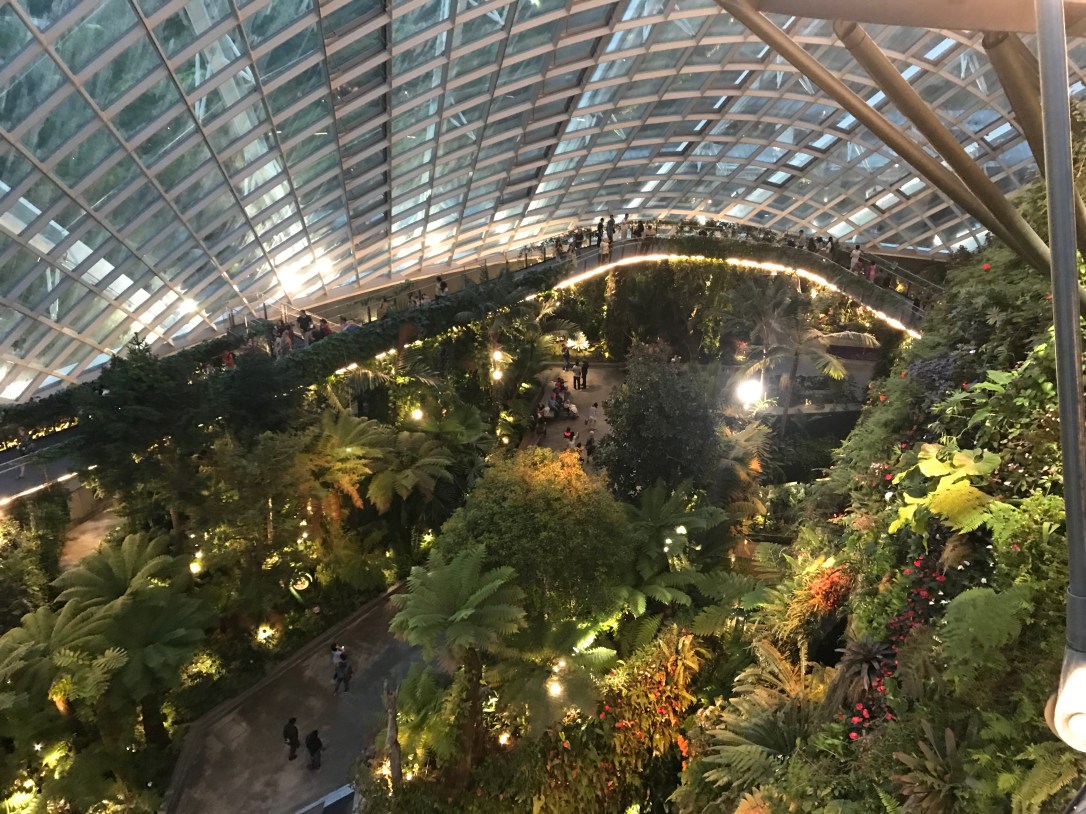
Next we headed back to Gardens by the Bay (3rd time in 3 days) to see the Cloud Forest, a large covered greenhouse filled with tropical plants.
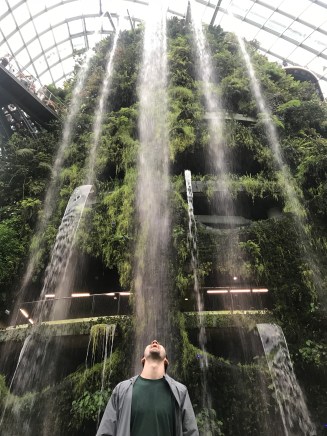
Afterwards we took a walk to the Singapore Flyer ferris wheel but turns out it was closed due to technical issues 😦 Not our day, I guess.

Departure
Unfortunately the next day was our last in Singapore so we had to make the most of it. After packing up we headed to the famous Liao Fan Hawker Chan Soya Sauce Chicken Rice which has a Michelin star. For $1.50 a dish this is the cheapest Michelin star meal in the world! The chicken was incredible and certainly gave Tian Tian a run for its money.

Determined to spend our remaining day in Singapore eating, we walked to Lau Pa Sat food center for lunch. It was crowded with professional-looking people, which made sense since it was noon on a Monday. The food was decent but Maxwell Centre still takes the cake IMO.

After that it was time to head to the airport where we loitered for another few hours. Amusingly we walked by a toy store called “Kaboom,” a name which seemed inappropriate given the location.
And with that our time in the fine city of Singapore sadly came to an end. Our next stop: Bali, Indonesia!

 Mikhail's Travel Adventures
Миша, потрясающе! Твои блоги становятся все лучше и лучше! Хочется туда поехать!
LikeLike