
After the adventures in Cambodia I pulled up my Angkor and headed to Vietnam!
Located on the Indochinese Peninsula, aka Mainland Southeast Asia, the Socialist Republic of Vietnam is one of four present-day Communist countries. This exclusive group also includes China, Cuba, and Laos.
Vietnam’s population is ~100M and its capital is Hanoi, in the north. However, the most populous city / industrial capital / economic center is Ho Chi Minh City (HCMC) in the south. HCMC was formerly named Saigon.
The Vietnamese currency is the dong, and USD exchange rate is crazy: $1 US is about 23,000 dong. As one of my tour guides put it, “we’re all millionaires in dong.”
I started my Vietnam journey in HCMC, and in 2 weeks worked my way up to Hanoi.

Brief History
Disclaimer: this isn’t a history blog, only a wannabe one.
The Vietnamese nation was under Chinese imperialism for much of its ancient history. In the 10th century AD, after about 1200 years, Vietnam won back its freedom and became an independent monarchy. Skipping a few years, in the 19th century France colonized the Peninsula, and Vietnam (along with present-day Cambodia/Laos) became French Indochina.
During WWII, Japan invaded French Indochina, which caused Japanese troops to be stationed in Vietnam. In 1941 Ho Chi Minh (“Uncle Ho”) emerged as a Vietnamese leader and saw Communist revolution as the way to freedom. He created the Viet Minh, a nationalist resistance movement, which gained popularity as Japan exploited Vietnam’s resources.
At the 1945 Potsdam Conference the Allies drew up a post-war plan for Vietnam: Japanese forces stationed in the south would surrender to the British, while Japanese forces in the north would surrender to the Chinese. Around the same time, the Viet Minh took control of the Vietnamese government when Uncle Ho persuaded (!) the emperor to abdicate.

Right after France’s armistice with Japan, Ho Chi Minh declared Vietnam’s independence from France, borrowing language from the US Declaration of Independence. The Chinese and British forces entered Hanoi and Saigon, respectively, per the agreement. The Chinese accepted Uncle Ho’s Hanoi government, but the British refused to do so in the south, deferring to the original colonizers the French.
The French continued to cause trouble, a few weeks later overthrowing Uncle Ho’s Saigon government. The Viet Minh then went underground and started a guerrilla war in the South against the French; in 1946 this turned into a full-blown war – the First Indochina War – with weapons supplied by the Americans, Chinese, and Soviets.
In 1954 the French lost, and the Geneva Conference decided that communist Viet Minh would control North Vietnam. At this point the French peaced out and the North and South were officially separated by a demilitarized zone, with the US taking control of the South. There was a 300-day free movement period, during which ~1M northerners (mainly Catholics) moved south for fear of Communist persecution.
Peace didn’t last long as the Vietnam War (also known as the Second Indochina War and in Vietnam as the Resistance War Against America) began soon after. The Viet Cong (VC), a pro-North communist revolutionary organization, began a guerrilla military campaign to overthrow the South Vietnam government, and within a few years had the USSR’s and China’s official support. Hoping to stop the spread of communism, the US increased their involvement as well, using the Gulf of Tonkin incident as justification.
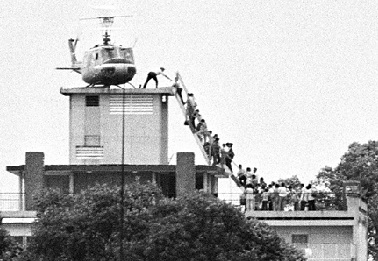
It was now Uncle Sam vs Uncle Ho. Internal US opposition and international condemnation grew as more and more US troops were sent to fight a questionable Vietnam War. This pressure was coupled with a lack of military progress, and the US adopted a policy of “Vietnamization,” eventually withdrawing in 1973. After this the North became OP and eventually won: the war ended with the Fall of Saigon in 1975. At that point several things happened: the North and South merged, Saigon was renamed Ho Chi Minh City, and 300k South Vietnamese military officers / government employees / supporters of the former government were sent to reeducation camps.
Today, Vietnam’s political system has evolved beyond traditional communism. Significant changes happened at the 1986 Party Congress, with reforms to transition the planned economy to a “socialist-oriented market.” The government encouraged private ownership of farms and factories, as well as foreign investment, while maintaining control over strategic industries. As a result the economy experienced significant growth, and today Vietnam has the 36th-largest GDP in the world. Not bad!
Arrival
Now, back to the present day. Still in Siem Reap, I ate my final Cambodian Burger King meal and boarded my flight.
Upon landing I bought a SIM card, called a Grab to my Airbnb, and waited for it with my phone out. Some guy who seemed like he could’ve been my driver came up and assertively told me to get in his car; luckily, I had my wits about me and checked the license plate. Potential crisis averted!

The real driver finally arrived, and after some traffic (a common theme here in SE Asia) I checked in.
The first thing that jumped out was the amount of motorbikes on the streets – there were more bikes than cars! It felt like everybody and their grandmother rode motorbikes, which wasn’t too far off: there are 7 million motorbikes for HCMC’s 9 million people. Their popularity makes sense not only economically but also practically: parking is a challenge in such a dense and chaotic urban environment.
After running a few errands I grabbed a tasty dinner on Backpacker Street, signed up for a walking tour, and headed to bed.
War Remnants Museum
The next day I first tried my luck at obtaining a visa for the upcoming Taiwan portion of my trip. Sadly, the Taiwanese embassy was on lunch break when I arrived (and the line was too long), so I punted the issue to future Mikhail.

Self-liberated, I left the line and carried on with my day.
Next on my itinerary was the War Remnants Museum. This museum was all about the Vietnam War from the Vietnamese perspective (naturally). It was extremely well put together and had a lot of interesting information that I didn’t remember learning (maybe wasn’t even taught) in history class. I particularly enjoyed the first exhibit – a detailed war timeline with lots of background info.
I learned a lot and felt a lot. Some exhibits were pretty gruesome, particularly the ones about war crimes and Agent Orange – an extremely toxic defoliant used by the US military to clear the jungle, whose devastating effects are still felt today. I briefly walked through one of these exhibits and couldn’t even handle going into the other.

Overall I had a really powerful and eye-opening visit, and left in a somber mood. 100% a must-see for anyone visiting HCMC.
Independence Palace
Next I walked to the nearby Independence Palace, also know as Reunification Convention Hall.
The palace was the home and workplace of the South Vietnam President during the Vietnam War, and was literally where the war ended. On April 30, 1975, a North Vietnamese tank crashed through the palace gates to find the South Vietnamese president and his advisors sitting in chairs on the steps, ready to turn over the government.

The palace was an impressive building with some fancy rooms, although sadly not much information for tourists.


Bitexco Financial Tower
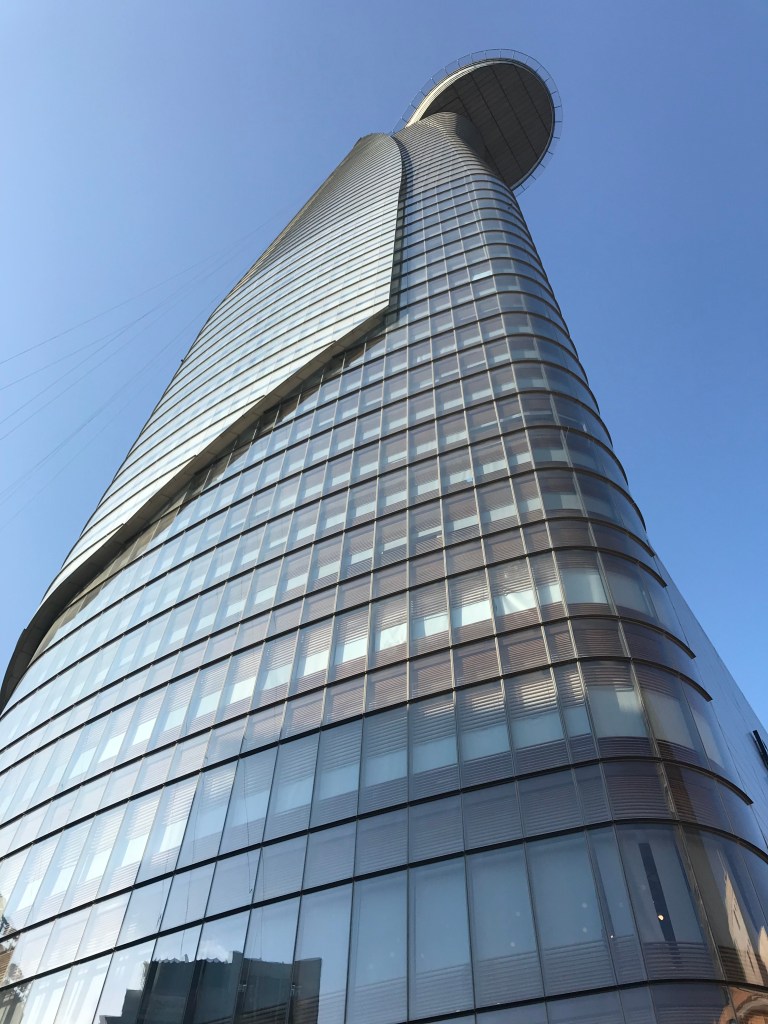
After the palace I went to watch the sunset from the 2nd tallest building in Saigon, Bitexco Financial Tower. Per one of the signs, the tower is “a proud symbol of Vietnam’s new wave of growth and prosperity.”

The tower was designed by famous architect Carlos Zapata who drew inspiration for it from the lotus, Vietnam’s national flower. The coolest feature is the protruding helipad on the 52nd floor, meant to look like a blossoming lotus bud!

My phone died capturing the views so I headed to the downstairs mall to find a charging port. I asked around and was finally directed to the movie theater waiting area, where I found an unoccupied cable that didn’t work. I asked the guy next to me if I could test his to see if the setup was even operational; the guy was really nice and said I could just use his cable! I charged up to 10% and walked back home, grabbing dinner on the way.

Free Walking Tour
The next day I woke up bright and early for my Free Saigon Walking Tour. I grabbed some pastries and headed to Ben Thành Market, the meeting point.
There I met James, the tour guide, and found out that this was going to be a private tour! James was a friendly college student studying tourism, in his last year. He said he didn’t study too hard and in his free time played games and took care of his 100 (!) fish. I was pumped to spend the morning with him!

Our first stop was “antique street,” my first lesson in Vietnamese culture. It turned out that in HCMC, stores that sold the same type of items were co-located on the same street to promote competition. This means that all the book stores are located on “book street” and all the computers are sold at “computer street.” What a concept!
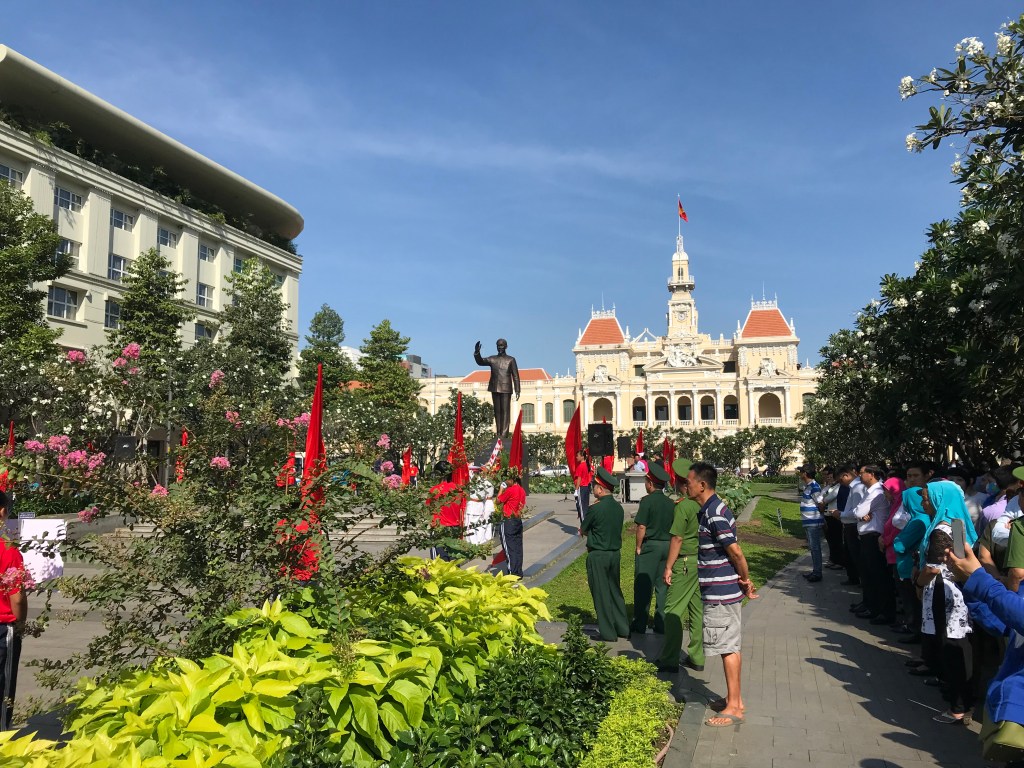
Next we headed to Saigon walking street and walked toward City Hall.

Afterwards we walked to the Saigon Opera House and checked out a French photographer’s nearby art gallery.

Next we walked by the “Fall of Saigon” building (the one from the CIA helicopter photo) and grabbed some tasty coffee at the aptly-named Cong Cafe.

Next up was the Notre-Dame Cathedral Basilica of Saigon, built by French colonists in the late 1800s.

The next stop was Saigon Central Post Office, also built in the late 1800s.

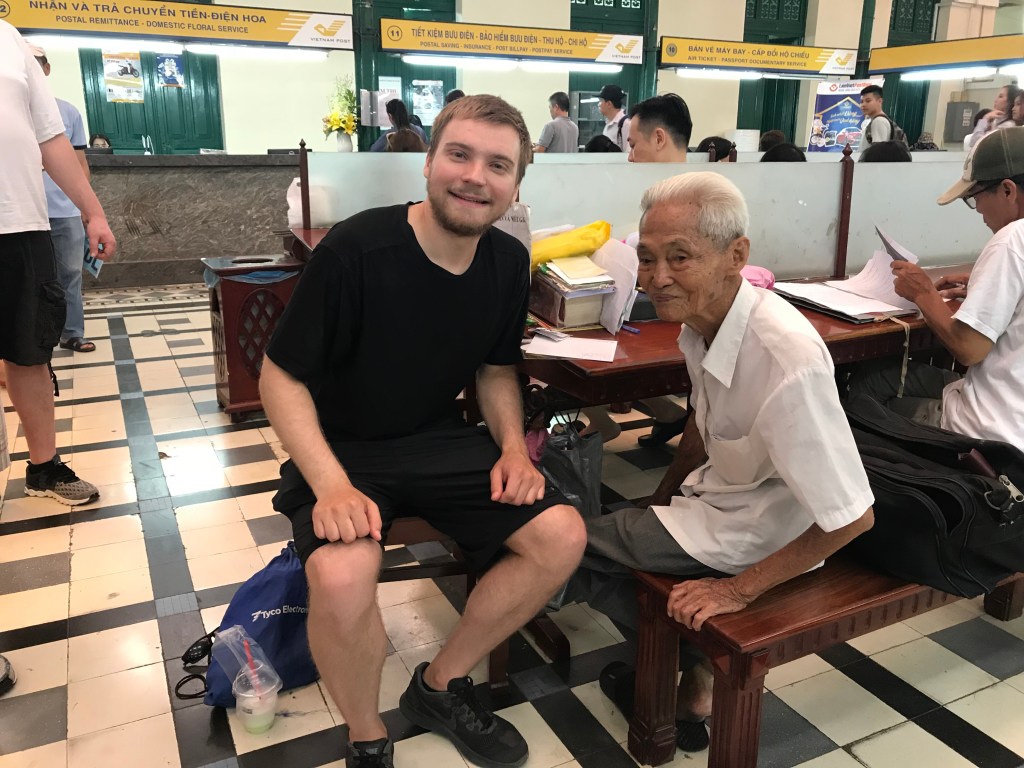
The highlight here was meeting Duong Van Ngo, a public writer for nearly 30 years (James said 60 years). He sits behind a sign that says “Information and Writing Assistance” and his job is to translate and write letters for people. Despite being in his late 80s, Mr. Ngo is on top of his game: he told me that he rides his bike to work every single day! He was a really friendly guy and signed a few postcards for me.
Our final stop was the Museum of Vietnamese History. James didn’t go in with me, since it probably would’ve been his thousandth time (the guy studied tourism, after all). I had a fantastic time and particularly loved learning about early Vietnamese history, circa Han Imperialism. This, coupled with what I learned at the War Remnants Museum, painted a very impressive picture of the Vietnamese people in my mind. So much resilience and heart!

After an hour at the museum I met up with James and we Grabbed back to our starting point. I thanked him profusely, picked up some lunch, and went home for a little siesta.

Cu Chi Tunnels
After lunch it was time for another tour: this next one was to the Cu Chi Tunnels.
I boarded the tour bus and had some nice chats with fellow passengers; our guide, though, completely stole the show. He must have been a comedian because his jokes (mostly of the “dad” variety) and delivery were just so good. He started off by saying that him and the driver drink 50 beers every day, and that the people who call Ho Chi Minh City Saigon are the ones that don’t like communism. My favorite was his description of the local weather: Saigon has 2 seasons – “hot” and “so hot.” Apparently when it’s 16C outside many old people die from such a temperature drop.
The tour guide also talked a bit about the motorbike craze. Apparently, one motorbike can legally hold 2 adults and 1 child under 12, a law that seems to be violated left and right. The Vietnamese must have learned from the best magicians, as they routinely seem to fit huge families (mom, dad, grandparents, a few kids) onto a single bike.

Now, the tunnels. Built in 1946, they were used by the Viet Cong as hiding spots, supply lines, and hospitals. The Cu Chi Tunnels are part of a much larger tunnel network that extends through much of Vietnam, but are impressive in their own right: 3 layers deep and over 200km long, they housed 17k VCs over 20 years.
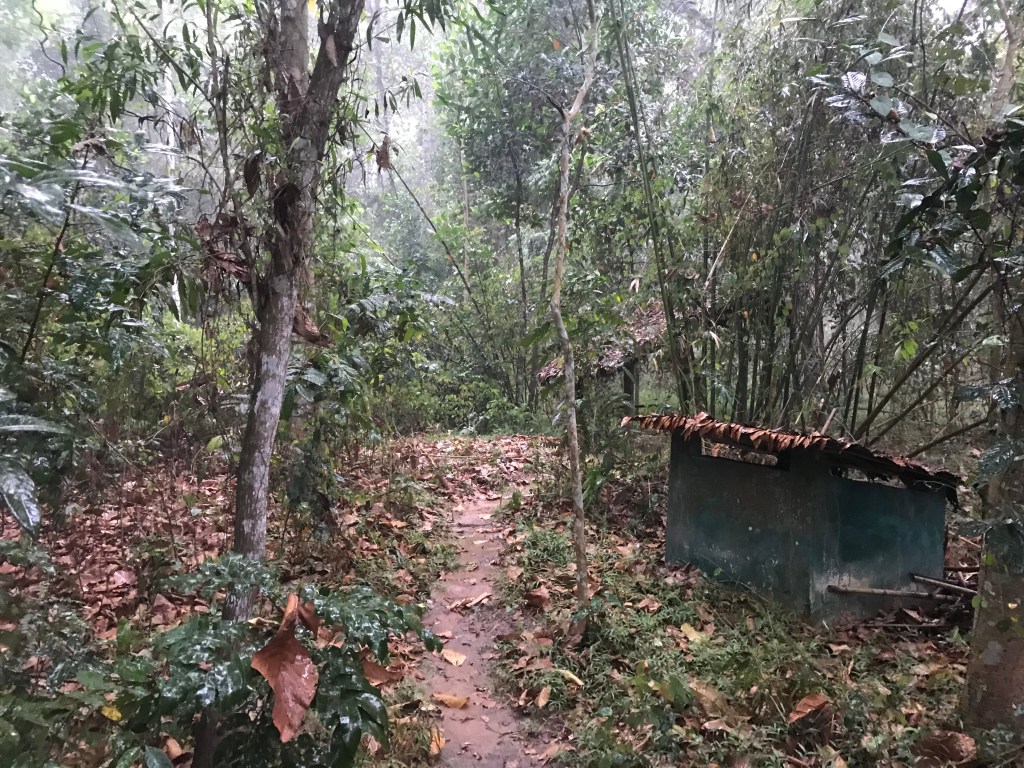
After the 1.5 hour ride we arrived in the deep jungle. Our group took turns climbing down and confirming that the tunnels were small and hard to get through. I later learned that the part we saw was enlarged for tourists…
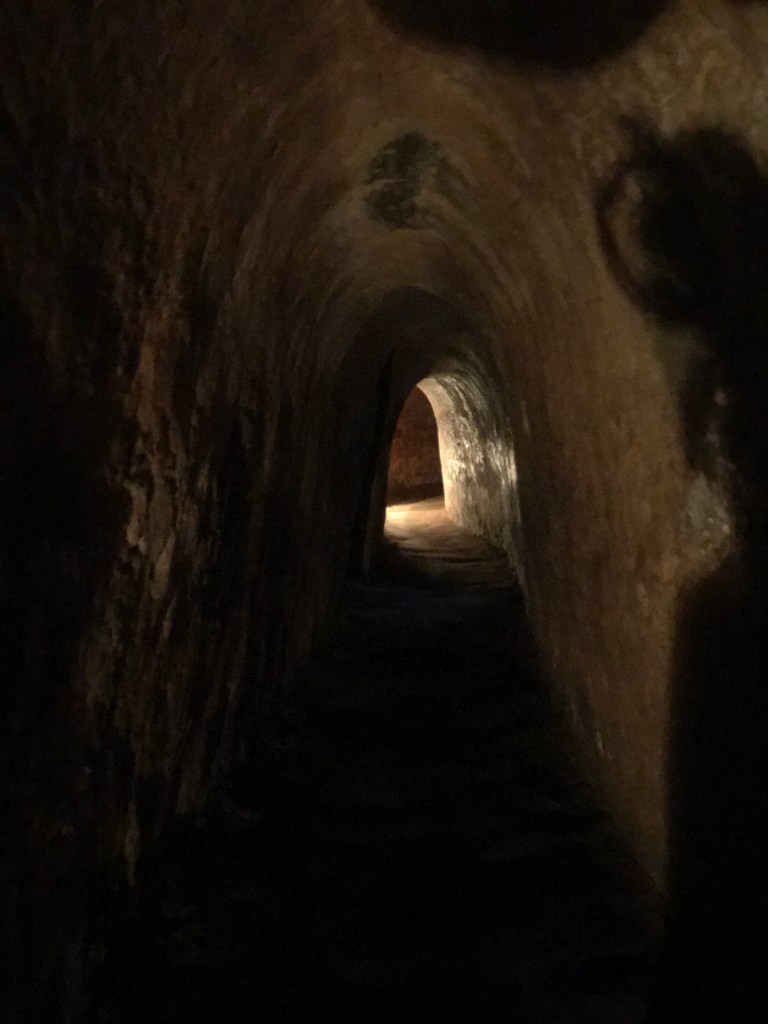
We also learned about tunnel life. The Viet Cong (farmers by day and soldiers by night) devised a number of strategies to conceal themselves from American soldiers; these strategies revolved around speaking without sounds, walking without traces, and cooking without smoke.
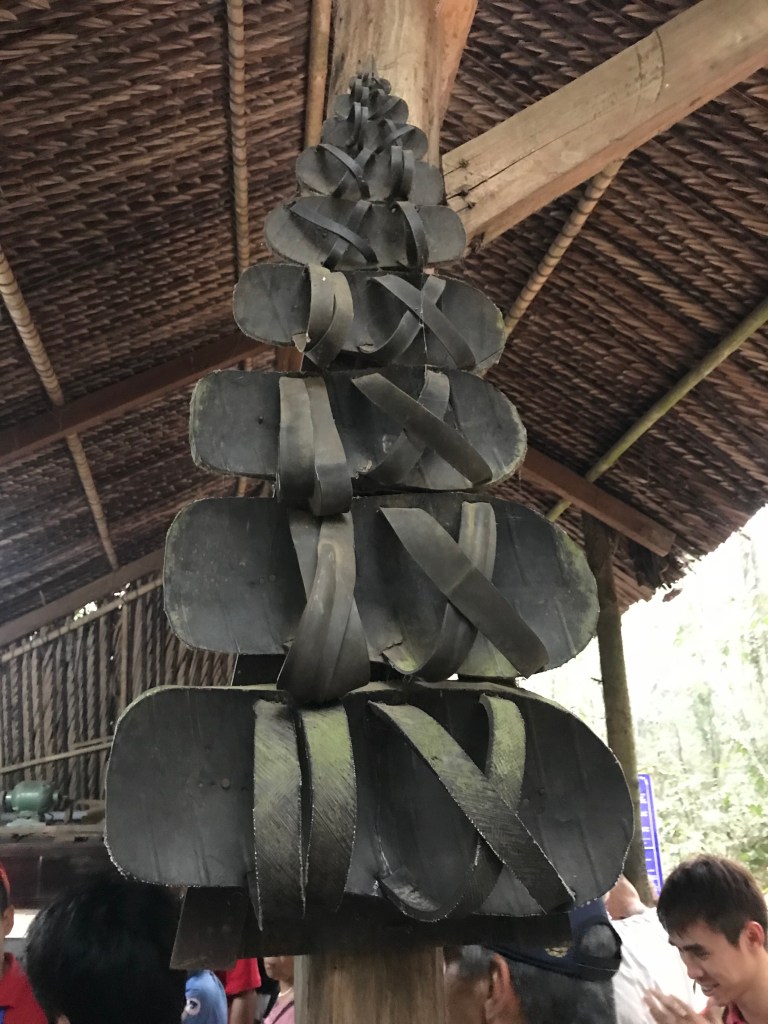
To keep things discreet the Viet Cong made sandals out of discarded tires, called Ho Chi Minh sandals. This created “footsteps” that made it look like their owner had walked in the opposite direction. Our guide joked that in the past you could wear Ho Chi Minh sandals to confuse your girlfriend when you went out with another girl, but “nowadays, ladies have GPS.”
The tunnels had air holes, and the VC stuffed them with chili peppers and GI uniforms to confuse the dogs.
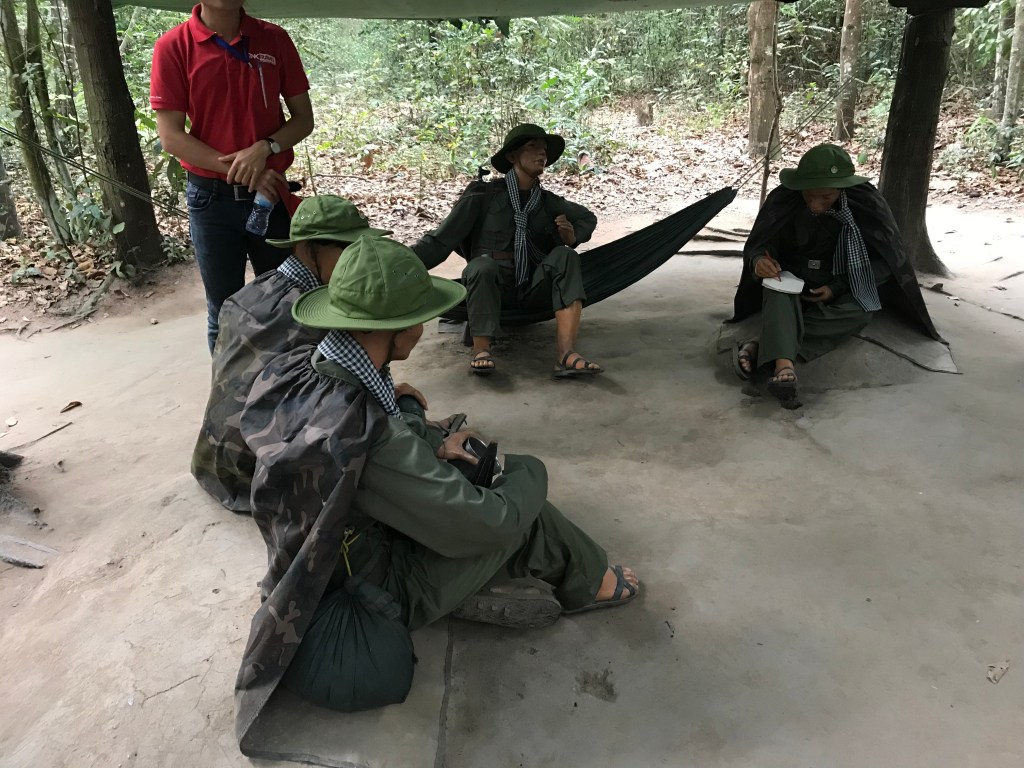
Cooking incognito was also more difficult: to remain undetected, the VC would let out smoke from their fires little by little around 4-5am so that it would mix with the morning fog. There was also limited meal selection in the jungle, so as our guide put it, “if it moves you can eat it.” Closing the loop of the food cycle, using the bathroom whilst in a tunnel required the occupants to dig a hole.

To make life difficult for GI “tunnel rats,” the Viet Cong put snakes and other insects inside the tunnels. These weren’t the only surprises, however: there was also an accompanying series of simple but effective booby traps laid throughout the nearby jungle.


At the end of the tour we got caught in some insane rain. Everybody got soaked, but luckily our guide had better snacks than the Viet Cong, and we dried off drinking tea and eating sweet potato. Afterwards we watched a heavy video about the tunnels and jungle fighting, but the group wasn’t feeling it (the pro-North propaganda didn’t help), so we headed back early.
After returning to the city I grabbed some Bun bo Hue, as recommended by some new friends from the tour. I got my hopes up as the place was crowded full of locals, but my experience didn’t live up to the hype: the soup was decent but not as good as pho IMO. It also didn’t help that I overdid it with the chili peppers and had to fish them out after my mouth caught on fire. Still hungry afterwards, I walked to Pho Quynh for some classic beef pho. Much better!

After the double meal I headed home and called it a day.
And with that, my time in Ho Chi Minh City came to an end. Next stop: Hoi An!

 Mikhail's Travel Adventures
1 thought on “Vietnam I: Ho Chi Minh City (3/4/18)”